
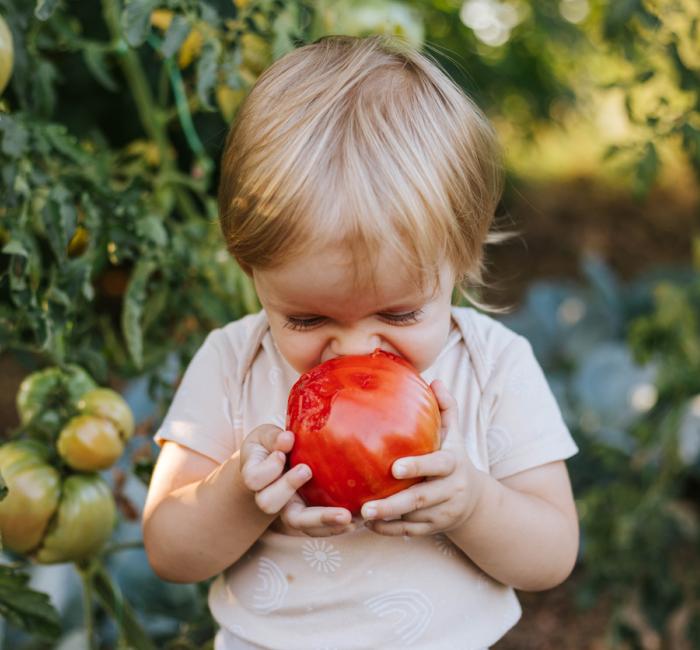

What are kids really saying?
Often, kids will say, “I don’t like that!” and adults will assume it’s due to taste and remove it. However, it’s important to understand why kids reject certain foods, and what they really mean when they say, “yuk!”
Taste is not the main reason kids will reject a food we serve up. They say no for many reasons that can be overcome, including texture, colour, shape, or even the way it’s presented.
Engage all the senses, not just taste
Children are primarily driven by the sensory properties of foods, so appearance and positive associations are particularly important when introducing vegetables. We know that:
- Bright and atypical colours, like purple cauliflower, can increase children’s willingness to try them
- Fun shapes are preferred over slices/sticks/chunks
- Several studies have found a preference for raw vegetables over cooked (depending on the vegetable)
- Vegetables with unique textures have low appeal with children. For example, mushrooms can be rejected due to their slippery texture. Cherry tomatoes have high textural contrast – crisp on the outside and soft inside so are more likely to attract mixed responses.
Kids do have different taste preferences to adults
It’s not your imagination – kids’ perception of foods is different from adults. Just a few of the key differences include:
- Children are more sensitive to bitter tastes and less sensitive to sweet taste.
- Kids do develop preferences for salty and energy-dense foods – perhaps to ensure they have the fuel their bodies seek to grow.
- Appearance is the most important property for 4 to 5 year-olds when choosing whether to eat a vegetable. Looks really count in the early years!
So, differentiating between preferences and genuine dislikes is key to preventing long-term fussiness with vegetables. Although some innate preferences might influence which foods kids say they want, parents and caregivers have much more sway than they may realise.
Two keys to success
There are really just two key behaviours for helping kids to love their veggies:
1. Repeated exposure: remember the 10 times rule and don’t give up after a few rejections! Simply continuing to try a vegetable will increase its acceptance. Modelling consumption of vegetables can really help – watching you eat a particular food increases their exposure.
2. Associative conditioning (make it fun!): put simply, this is the process of transferring the positive value of one thing to another by repeatedly combining them. This can be as simple as offering the vegetable with another taste the child likes, or the food being offered by someone the child likes or admires (peers/siblings can help!). The food can also be presented in a fun and engaging way that makes a positive emotional connection to the food.
Many vegetables have some properties that kids might resist: a slightly bitter taste (which we know they are more sensitive to) and challenging textures that require a lot of chewing. But, if we focus more on the experience of the food rather than the taste, we can create less ‘fussiness’ in the longer term.
How much is enough?
Deliberately cultivating a love of vegetables is part of our life-long wellbeing. According to the CSIRO VegKIT project, by the age of two, kids need to be eating 2 ½ serves of veggies each day. By the time they are teenagers, they need to be eating 5 to 5 ½ serves every day. A serve is roughly 75g, or half a cup of cooked veggies or pulses, or one cup of fresh.
Following a healthy diet in childhood is important for normal growth and development and can also reduce the risk of diseases such as diabetes, cardiovascular disease and some cancers later in life.
Repeated exposure and positive associations are the keys to helping kids develop a love of a wide range of veggies from the outset. So, try whenever possible to:
- Make vegetables readily available and part of everyday life, including by modelling vegetable intake yourself.
- Help children build familiarity with new things: allow kids to explore vegetables in different ways. Just touching and smelling foods will help with future acceptance.
- Reduce the availability of other foods with low nutritional value to avoid competition.
- Involve kids in food preparation—chopping and mixing vegetables (as well as picking things out in the supermarket or from your own garden) all helps build familiarity and interest.
Be inspired with all these fun, easy recipes made just for kids!
REFERENCES:
- https://www.vegkit.com.au/globalassets/vegkit/documents/best-practice-guidelines-for-inreasing-childrens-vegetable-intake.pdf
- World Health Organisation. Increasing fruit and vegetable consumption to reduce the risk of noncommunicable diseases. 2019 [cited 2019 9th October 2019]; Available from: https://www.who.int/elena/titles/fruit_vegetables_ncds/en/
- https://www.vegkit.com.au/globalassets/vegkit/documents/industry--growers/vg16064_industry-report_concepts.pdf